
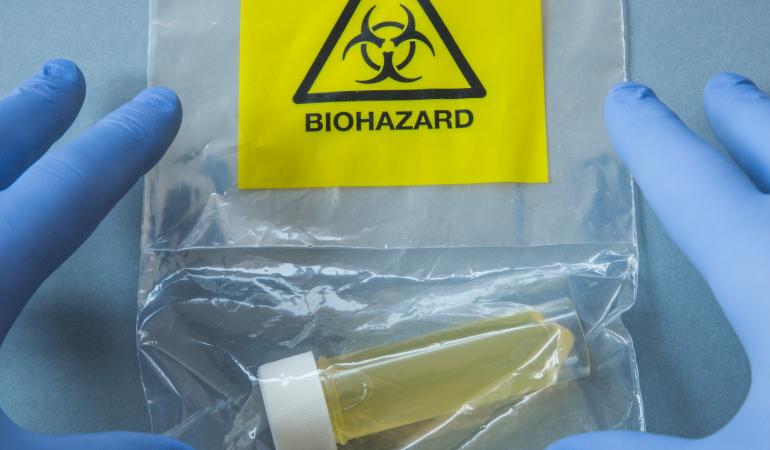
Recently, it was reported in the news that two researchers in the US are suspected of illegally importing a fungus that can cause significant damage to agricultural crops. Do you ever travel internationally with biological (high-risk) research materials, or do you send such materials abroad? Then it’s important to know how to do this safely.
Recently, the public prosecutor in the US state of Michigan announced that two researchers from China are suspected of (among other things) attempting to smuggle a fungus into the United States that is considered a “potential agro-terrorism weapon” [1,2]. Yunqing Jian and Zunyong Liu both conduct research on the fungus Fusarium graminearum. This fungus can cause head blight in cereal crops such as wheat, buckwheat, and corn. The toxins produced by head blight can cause vomiting, liver damage, and birth defects in humans and animals [1,3]. Jian held a position at the University of Michigan and received support from the Chinese government to work on research involving Fusarium graminearum. Furthermore, investigations by US authorities revealed that she is a loyal member of the Chinese Communist Party. Liu works at a Chinese university on research into the same fungus. At Jian’s request, Liu brought the fungus to the US [3,4]. He hid the fungus in his backpack when he attempted to enter the United States [4].
Fusarium graminearum is a fungus that is already common in the US [3]. Crops infected with the fungus are dangerous for humans and animals and are destroyed, causing significant losses for farmers. For this reason, the Michigan prosecutor argues that the fungus could be used as a bio-terrorism weapon in agriculture. Fungal experts do not consider Fusarium graminearum to be the most dangerous potential weapon, but emphasize that the consequences of an outbreak could still be serious [3]—especially if it involves a strain that does not naturally occur in the US or is resistant to fungicides. It is unknown which strain Jian and Liu were carrying.
The import and export of high-risk fungi (and other biological materials) are strictly regulated both in the US and in the Netherlands. Jian and Liu most likely failed to follow the required procedures for exporting and transporting high-risk biological materials. The investigation into both suspects is ongoing.
Regulations on the Import and Export of Biological Materials
There can be valid reasons to travel abroad with biological materials such as fungi or to send them internationally. Make sure to do this legally and comply with all laws and regulations. In the Netherlands, the transport of biological material is governed by the Carriage of Dangerous Goods Act (WVGS) and the Aviation Act. These are further detailed in the Decree on the Carriage of Dangerous Goods (BVGS) and the Decree on the Carriage of Dangerous Goods by Air. Technical requirements are described in additional regulations, such as the Regulation for the Carriage of Dangerous Goods by Road (VLG), the Regulation for the Carriage of Dangerous Goods by Rail (VSG), and the Regulation for the Carriage of Dangerous Goods by Inland Waterways (VBG). These laws and regulations also include international agreements on the transport of dangerous goods. Therefore, the legislation applies both to the transport or shipment of biological materials within the Netherlands and to or from other countries. More information about the relevant laws and regulations can be found on the Bureau Biosecurity website. To avoid problems with customs and to reduce risks for yourself or the carrier, it is important to follow the requirements set out in these regulations.
Please note! Additional rules may apply, especially when dealing with high-risk materials:
- For the transport or import of quarantine organisms, or for the import of animals or animal products, additional regulations may apply. An exemption or import permit from the Netherlands Food and Consumer Product Safety Authority (NVWA) may also be required.
- If the material or goods you want to transport across the border are listed on the Strategic Goods List, you are required to apply for an export control license from the Central Import and Export Service of the Ministry of Foreign Affairs before transporting or shipping the material. This list includes biological materials with a high risk of dual-use applications, but an export license is also required for so-called ‘intangible goods’ related to these materials, such as knowledge, research results, or technologies.
More information about transport and export control can be found hier.
[1] Eastern District of Michigan | Chinese Nationals Charged with Conspiracy and Smuggling a Dangerous Biological Pathogen into the U.S. for their Work at a University of Michigan Laboratory | United States Department of Justice
[2] Chinezen smokkelen gevaarlijke schimmel naar VS die bekendstaat als ‘mogelijk agroterroristisch wapen’ | Buitenland | AD.nl
[3] What to know about Fusarium graminearum, the biological pathogen allegedly smuggled into the US - ABC News
[4] What is Fusarium graminearum, the fungus 2 Chinese researchers are charged with smuggling into the US? | CNN